Sunday, 2 August 2015

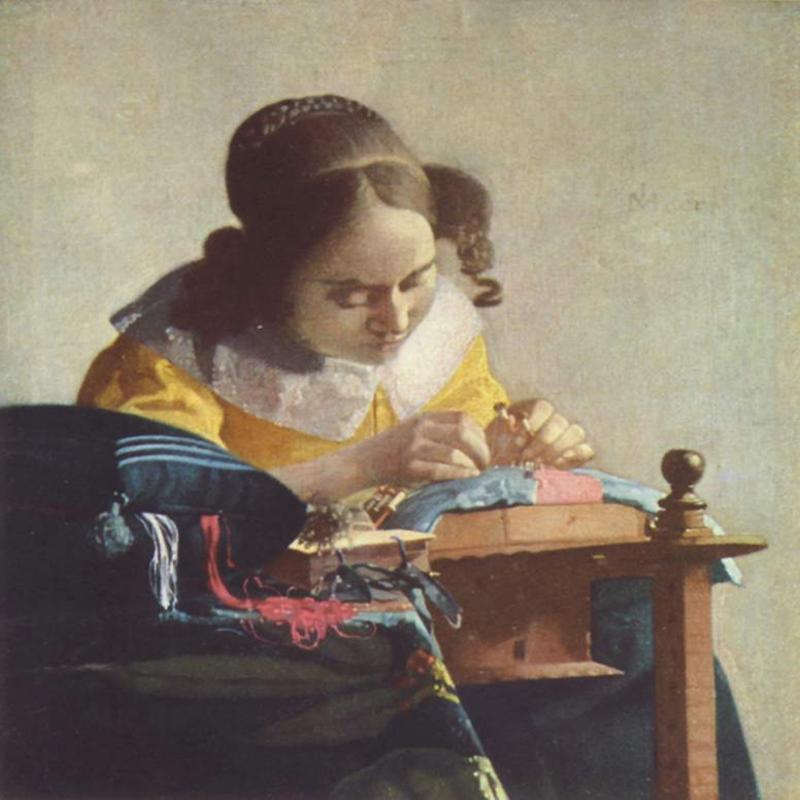
Jan Vermeer; Magic as Light

Born on 31 October 1632, Johannes Vermeer was barely known outside of his hometown of Delft in the Netherlands where a local celebrity, at least as a painter of some distinction, he found patronage enough to provide for his wife and ever increasing family.

But following his death in 1675, aged just 43, he was speedily forgotten only being rediscovered in France in the 1860’s. His reputation has since soared and he is now considered to be one of the premier Dutch Masters.

Yet he only produced 34 known paintings during his lifetime leaving no etchings or preliminary drawings and his subject matter was limited rarely painting beyond the parameters of his own physical and emotional awareness with one or two rooms of his modest house, the furniture artfully reassigned, becoming the tiny sphere of his creativity.

With the emphasis on light and colour he daubed the canvass with a delicacy and precision that would leave a paintbrush barely tainted and in doing so created images of crystallised perfection.

His alleged use of the Camera Obscura, a box that captures and preserves the image reflecting it upon a canvass or wall whilst also maintaining both its colour and perspective remains controversial.

His unrushed and sober style of painting has seen him accused of lacking both dynamism and daring and drawn comparisons with his contemporaries most notably Rembrandt.
 

But whilst Rembrandt, for whom there could never be enough paint, revealed beauty in the grime and filth of everyday life and sought respect through the willingness to offend, Vermeer painted unblemished visions of perfection leaving the space of eye and thought for the suggestion of others.


Monday, 15 June 2015

Magna Carta


Most great change comes about as the result of conflict of one sort or another and the chaos that invariably ensues as a result. Never is this more so than in the realm of politics and alterations to the balance of power. Now and again such change creates a legacy and invokes a memory that goes far beyond its original intent and indeed the imagination of its protagonists.


The meeting between King John I and his Barons on the field of Runnymede on 15 June 1215, and the document it subsequently produced is one of those moments.

Article 39 and 40 (The Justice Clause)

“No free men shall be seized or imprisoned or stripped of his rights or possessions or outlawed or exiled or deprived of his standing in any way nor will we proceed with force against him or send others to do so except by the lawful judgement of his equals or by the laws of the land.”

“To no one will we sell, to no one deny or delay right of justice.”

The Justice Clause is the most famous and the most often quoted of Magna Carta’s 62 Articles and has evolved to form not only the basis for the legal systems of liberal democracies around the world but also the judicial reference point for regimes in which the dispensation of justice is not entirely devolved from the practice of political power.

Articles 12 to 14 (The Taxation Clause)

“No scutage or aid (tax) may be levied within our Kingdom without its general consent.”
The King could no longer impose taxation upon his subjects without making provision for the calling of the (Barons) Council and the agreement of that Council.

The Taxation Clause of Magna Carta would be used to oppose the imposition of taxes by Charles I during the suspension of Parliament and the period of his personal rule.

It would also serve as the inspiration for the rallying cry of the American colonists of ‘No Taxation without Representation’ during the War of Independence.

Articles 60 and 61(The Security Clause)

“Since we have granted all these things for God, for the better ordering of Our Kingdom, and to allay the discord that has arisen between us and our Barons, and since we desire that they shall be enjoyed in their entirety, with lasting strength, forever, we give and grant to the Barons the following security:

The Barons shall elect twenty five of their number to keep, and cause to be observed with all their might, the peace and liberties granted and confirmed to them by the Charter.”

Also contained within it was the proviso that:

“The King shall seek to obtain nothing from anyone, in our person or through someone else, whereby any of these grants or liberties may be revoked or diminished.”

Arguably the most significant of all Magna Carta’s Clauses this for the first time saw restraints imposed upon Royal power and the prerogatives of the King.

If the King failed to abide by the terms of the Charter after notice had been given of his failure to do so by at least 4 of the 25 Barons on the Council and if any non-compliance continued thereafter then the Barons would be absolved of their Oath of Fealty and could take up arms against him.

The King was no longer the sole power in the land and the Security Clause would provide the principle upon which Parliament would oppose the Stuart Monarchy’s claim to rule by Divine Right.


Sunday, 17 May 2015

The Dambusters


On the night of 16 May 1943, as darkness descended, 19 Lancaster Bombers of 617 Squadron commanded by the 24 year old Guy Gibson took off from R.A.F Scrampton in Licolnshire armed with a new weapon - the Bouncing Bomb.

Their targets were the Mohne, Eder, and Scorpe Dams of the Ruhr Valley deep in the heart of industrial Germany, their intention to breach the dams, flood the surrounding area, and severely hamper German wartime production.
Flying barely 100 ft above sea level to avoid detection by enemy radar the planes instruments were not sophisticated enough to determine how far above the water they were and so a lamp was attached beneath each plane to light up the sea but even so one plane hit a wave and had to return to base.

Descending even further to just 60 ft to launch the attack, making it impossible to take evasive action, the planes became vulnerable to anti-aircraft fire from the heavily defended dams.
Having to fly at a precise speed and launch their bombs at an exact distance for them to be effective the Mohne and Eder Dams were breached with some 1,600 people, many of them forced labourers from Eastern Europe and Soviet prisoners-of-war being drowned as a result.


The Sorpe Dam remained intact, however.
One of the most daring raids of World War Two had achieved only partial success with the dams soon repaired and German war production barely effected, though the Nazi Minister of Munitions was later to say that it had come close to being a catastrophe for German industry.

But with its audacity, its inventiveness, the courage of the men involved, and the flying of the pilots the Dambusters Raid caught the imagination of the British people and was a great morale boost during the darker days of the war, but it had been bought at a high price - of the 18 bombers that participated in the actual attack 8 were lost and 53 men of the 133 of 617 Squadron were killed.

Guy Gibson was awarded the Victoria Cross not for leading the hazardous raid but for remaining in the area after dropping his own bomb to draw enemy fire away from those planes still to do so.
He was killed in action 17 September, 1944.


Sunday, 3 May 2015

In Flanders Fields


On 3 May 1915, the Canadian Lieutenant-Colonel John McCrae who had just presided over the funeral of his friend Alexis Helmer killed at the Second Battle of Ypres wrote arguably the most famous poem to emerge from the First World War - In Flanders Fields.

Disappointed at the attempt to express his emotions and sense of loss  he threw the poem away.
 It was retrieved by one of his soldiers.

Like his friend McCrae did not survive the war, dying of pneumonia in January, 1918.

In Flanders Fields


In Flanders fields the poppies blow
Between the crosses, row on row,
That mark our place; and in the sky
The larks, still bravely singing, fly
Scarce heard amid the guns below.

We are the Dead. Short days ago
We lived, felt dawn, saw sunset glow,
Loved and were loved, and now we lie
In Flanders fields.

Take up our quarrel with the foe:
To you from failing hands we throw
The torch; be yours to hold it high.
If ye break faith with us who die
We shall not sleep, though poppies grow
In Flanders fields.


Thursday, 23 April 2015

Titanic


The last known image of the Titanic afloat.


Edward Smith, Captain of the Titanic who intended it to be his final voyage before retiring to spend more time with his family.


Collapsible A was recovered several months after the Titanic sank with three bodies still aboard.


Of the Titanic's 1,517 victims only 337 were recovered from the sea of these the millionaire Jacob Astor was fairly easy to identify with a gold pocket book, $2,400 and £225 on his person. As also was the
ship's Bandleader Wallace Hartley recovered with his music case and violin still strapped to his back.


Bodies recovered from the sea following the sinking of the Titanic that were identified as First Class passengers were provided with a wooden coffin whilst those identified as Second Class had canvass body-bags.
Third Class passengers were returned to the sea following a brief religious ceremony.
The bodies had to be laid out on deck to defrost before they could be interred in their temporary resting place.

More Images:


Friday, 30 January 2015

The Mayerling Incident


On 30 January 1889, Crown Prince Rudolf, heir to the throne of Austria-Hungary was found dead alongside his mistress, 17 year old Mary Vetsera at The Mayerling, an isolated hunting lodge.
At first it was announced that he had died of natural causes, most likely heart failure. Mary's death was kept secret, but not for long.
The official investigation that followed concluded that both Rudolf and Mary had died of gunshot wounds in what appeared to be a suicide pact.
The Emperor Franz Joseph now ordered all inquiries to cease.
Rudolf did not get on with his father, he was was liberal who associated with radicals and lent his support to those who demanded reforms.
He was a heavy drinker who frequented, clubs, brothels, neglected his wife and was heartily disliked at the Imperial Court for his outspoken views and discourteous manner.
He was also considered a liability by Austria's German ally without whose support the Empire would struggle to survive.
As the only son of the Emperor the Crown would now pass to Franz Joseph's brother Karl Ludwig but he renounced it in favour of his son the Archduke Franz Ferdinand.
No more liked than Rudolf he was at least a sober and level-headed man who took his responsibilities seriously, and his assassination on 28 June 1914, would prove the catalyst for war.
At Rudolf's funeral the Imperial Family remained barely fifteen minutes.
Was the Mayerling Incident a suicide pact? Or was it a politically motivated murder? Certainly many of Rudolf's relatives believed it was the latter.
Either way it remained a convenient death.

Crown Prince Rudolf

Mary Vetsera, Crown Prince Rudolf's 17 year old mistress.

Crown Prince Rudolf and Princess Stephanie, the wife he later ignored on the day of their engagement.